How to plan a counselling website to support your practice
For many counsellors, building a website can feel overwhelming, especially when you are also setting up or running a busy practice. It is often one of those tasks that sits in the background because it is not always clear where to start or what really matters.
But your website is not just another admin task. It plays an important role in how you present your practice, how potential clients understand what you offer, and whether they feel confident enough to get in touch.
In a crowded and often very similar-looking online space, your website is also what helps you stand out. Many counsellor websites end up feeling generic because they rely on the same templates and structures. While these can be a helpful starting point, they do not always reflect the individuality of your practice or your therapeutic approach.
A well-designed counselling website should feel like you, not like everyone else.
And importantly, you do not need to be a web designer to create something effective. In fact, simplicity is often far more reassuring for someone who may already be feeling anxious or uncertain about starting therapy.
This guide will walk you through how to plan a counselling website that feels authentic, calm, and supportive of your work, rather than something that adds pressure or confusion.
What is the purpose of your counselling website?
Before you think about colours, fonts, or platforms, it is helpful to step back and consider the purpose of your website.
Your website is not just informational. It is part of the decision-making process for a potential client. Someone visiting your site is often asking themselves:
“Is this the right therapist for me?”
That means clarity is more important than creativity. People are not looking to be impressed, they are looking to feel safe, understood, and reassured.
Your website also has a practical role in visibility. It helps you show up when people are actively searching for support. So while it needs to feel human and grounded, structure and wording also matter for search engines like Google.
A good counselling website therefore needs to do two things at once:
help people understand your work clearly
help people find you in the first place
Who will be visiting your website?
It is important to be realistic here; your website is not for everyone.
Instead, it should be designed with your ideal client in mind. This makes everything easier, from writing copy to choosing what information to include.
Most visitors to counselling websites are not browsing casually. They are often:
feeling anxious or overwhelmed
unsure about what therapy involves
trying to make a fairly personal decision
looking for reassurance and clarity
This means your website needs to reduce cognitive load, not increase it.
Simple navigation, clear language, and calm structure all help someone feel more at ease. The goal is not to overwhelm them with information, but to gently guide them towards understanding whether you feel like the right fit.
Decide what your counselling website actually needs
One of the most common challenges at this stage is trying to include too much information.
A helpful starting point is to think about what a potential client actually needs to know in order to take the next step.
For example:
What you specialise in and your qualifications
Whether you offer online or in-person sessions
Where you are based, if relevant
What someone can expect from the first session
How confidentiality works in practice
Starting therapy can feel like a big step, so anything you can do to reduce uncertainty will help build trust.
It can also be helpful to remember that many people do not know what therapy actually feels like. Simply explaining your process in a clear and grounded way can make it much easier for someone to reach out.
At a minimum, most counselling websites need:
A friendly photo and short introduction
Clear description of your services
Information about what you can help with
A simple way to contact you
It is also worth remembering that too much information can sometimes have the opposite effect. When people feel overwhelmed, they often do not take action. Clarity is more effective than detail.
You may also want to include trust-building elements such as:
Professional qualifications and memberships such as BACP or UKCP
Clear boundaries and ethical framework
A calm, professional tone of voice
Testimonials, if appropriate to your practice
How do you want your counselling website to feel?
Your website should feel like a natural extension of your practice.
For most counsellors, this means something that feels:
calm
safe
professional
grounded
human
Design plays a bigger role in this than people often realise. Colour, spacing, typography, and layout all influence how someone feels when they land on your site, often before they have even read a single word.
Soft, neutral colours, generous white space, and simple typography can all help create a sense of calm and ease. The aim is to support trust and clarity, not to distract or overwhelm.
It is also worth finding inspiration from other websites, but being mindful not to copy them directly. Instead, try to notice what feels good:
Is it the clarity of the layout
The simplicity of the navigation
The tone of the messaging
Then bring those principles into something that feels like your own practice.
A good counselling website sits somewhere between overly clinical and overly casual. It should feel professional, but still warm and human.
Plan for visibility from the start
It can be tempting to focus only on design, but thinking about visibility early on will make a big difference later.
Search engine optimisation, or SEO, is what helps your website appear when people search for support online. However, it is important to be realistic, trying to rank for broad terms like “counsellor” or “therapist” is extremely competitive.
Instead, more specific searches tend to be more effective, such as:
counsellor in CBT in Stoneleigh, Surrey
anxiety therapist in Epsom and online
People rarely search in general terms. They search based on specific needs. These longer, more detailed phrases are easier to rank for, and they also tend to come from people who are more ready to enquire.
It is helpful to naturally include these kinds of phrases in your website content, rather than forcing them in.
Other important visibility basics include:
making sure your website works well on mobile
setting up a Google Business Profile
ensuring your site is properly indexed by Google
SEO is something that builds over time, so it is important to be patient with it.
Blogging can also support visibility, but this is something you can build into your website later rather than feeling pressured to do immediately.
Keep the website design process manageable
One of the biggest barriers at this stage is perfectionism.
Many counsellors feel they need to get everything right before launching, but in reality, your website will continue to evolve over time. It does not need to be perfect in order to be effective.
A simple, clear, and thoughtful website is more than enough to begin with. You can always add more pages, content, or features later once your practice grows.
What matters most is that you actually have something live that represents you and allows potential clients to find and contact you.
Progress is more important than perfection here.
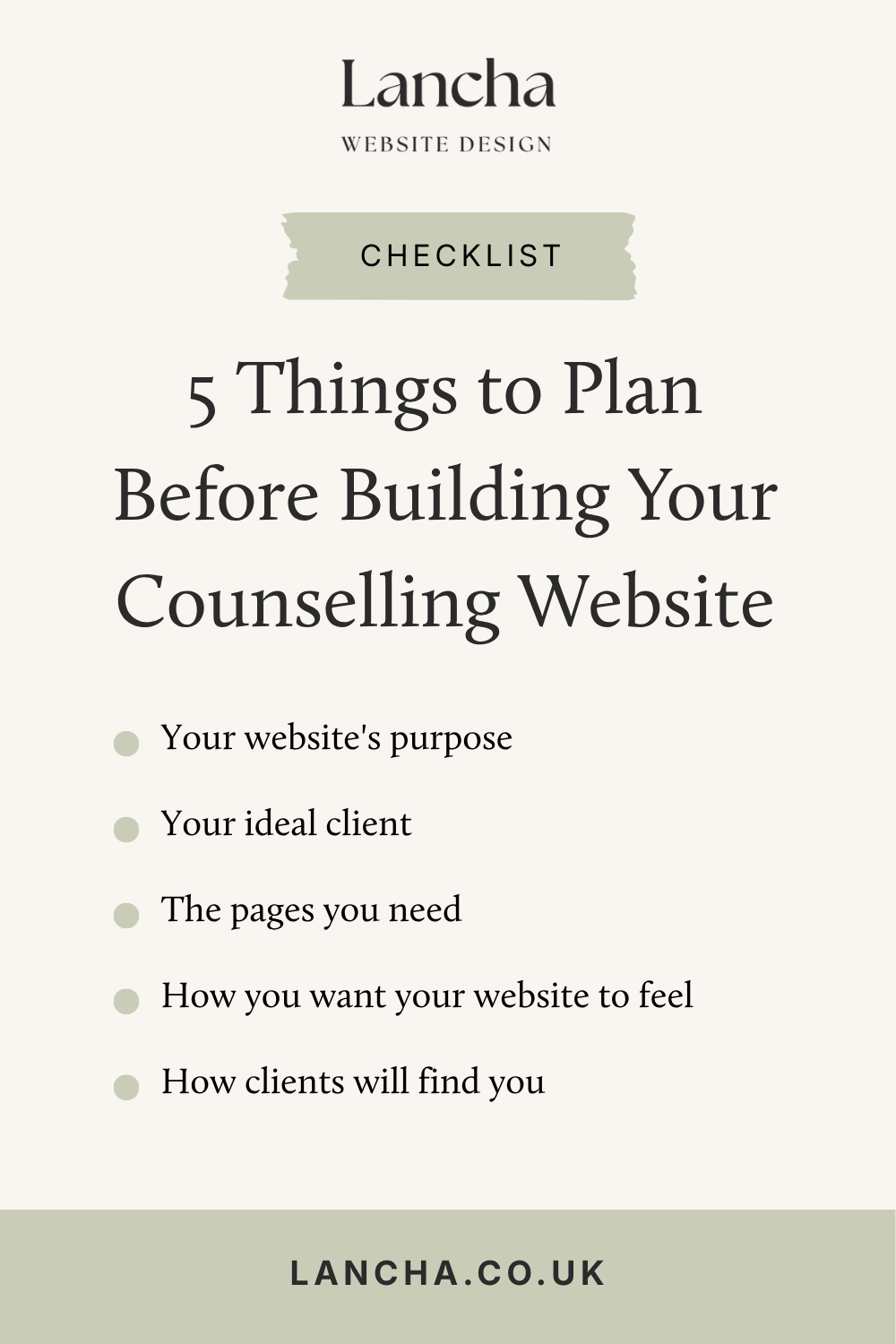
Planning a counselling website does not need to feel overwhelming. When you break it down into purpose, audience, structure, feeling, and visibility, it becomes a much more manageable process.
Your website does not need to be complicated to be effective. In many cases, the most successful counselling websites are the ones that feel the calmest and clearest.
If you're planning a new website for your private practice and would prefer support with the design and setup, you can find out more about my website design service for therapists in private practice.